Azure Firewall & DDoS Protection
The Castle Walls and Force Field
Simply Put...
Imagine your website is like a castle. You want to keep it safe from unwanted visitors and attacks. Azure Firewall is like having a very smart and strong gatekeeper at the castle entrance. This gatekeeper checks everyone who tries to enter or leave, making sure they are not on a list of known troublemakers. The gatekeeper also inspects what people are carrying to ensure they don't bring anything harmful inside. This keeps your castle safe from individual threats and unwanted intrusions. Now, think about a DDoS attack as a massive, unruly mob trying to storm your castle gate all at once. This mob is so large that it blocks the way for your real, friendly visitors. This is where Azure DDoS Protection comes in. It's like having a magical force field around your castle. This force field is smart enough to distinguish between the angry mob and your friendly visitors. It stops the mob in its tracks, far away from your gate, while allowing your friends to pass through without any trouble. This way, your castle remains open and accessible to the right people, even when a huge crowd is trying to take it down.
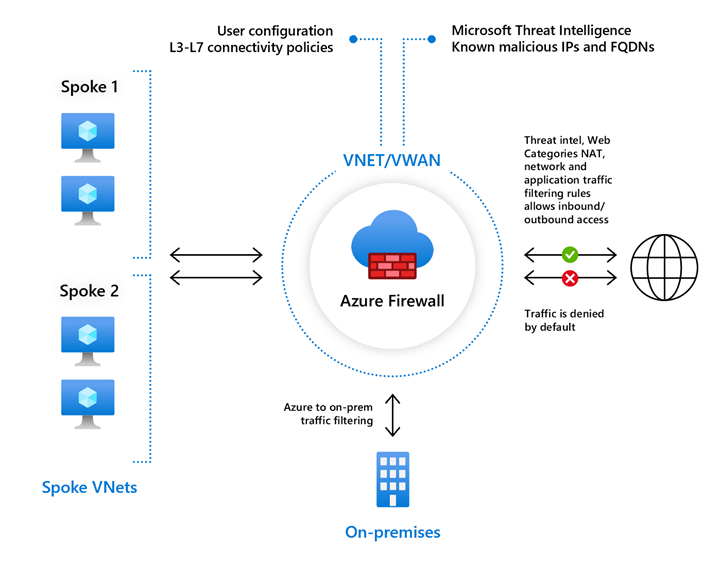
How it Works
Azure Firewall and Azure DDoS Protection work in tandem to provide layered security for applications and services in Azure. DDoS Protection acts as the first line of defense, safeguarding the virtual network from volumetric and protocol-based DDoS attacks at Layers 3 and 4. It continuously monitors traffic patterns and automatically mitigates threats in real-time. Once the traffic is scrubbed by DDoS Protection, it is then inspected by Azure Firewall, which provides more granular, stateful filtering at Layers 3-7. The firewall enforces security rules based on threat intelligence, application protocols, and custom policies to protect against a wider range of threats, including application-layer attacks. This combined architecture ensures comprehensive protection from both network-level disruptions and sophisticated application-level security risks.
Scalability Superpowers
Both Azure Firewall and Azure DDoS Protection are designed for high scalability to meet the demands of growing cloud environments. Azure Firewall automatically scales its throughput capacity to handle increasing traffic loads, ensuring consistent performance without manual intervention. The service's architecture allows it to accommodate traffic fluctuations and growth seamlessly. Similarly, Azure DDoS Protection is a globally distributed service with a massive mitigation capacity, capable of absorbing and neutralizing even the largest and most sophisticated DDoS attacks. This global scale ensures that applications remain available and performant, regardless of the attack's volume or origin.
Key Parts
- Azure Firewall: Stateful firewall as a service, L3-L7 filtering, Threat intelligence from Microsoft Cyber Security, Signature-based IDPS (Premium SKU), Built-in high availability and unlimited cloud scalability.
- Azure DDoS Protection: Always-on traffic monitoring, Adaptive real-time tuning, DDoS protection analytics, metrics, and alerting, Azure DDoS Rapid Response team, Multi-layered protection (with WAF).
Security Features
- 🛡️Threat intelligence-based filtering: Blocks traffic from and to known malicious IP addresses and domains in real-time.
- 🛡️Intrusion Detection and Prevention System (IDPS): The Premium SKU offers signature-based IDPS to detect and block sophisticated threats like malware and exploits.
- 🛡️Always-on traffic monitoring: Provides continuous, 24/7 monitoring of network traffic to detect DDoS attacks as they happen.
- 🛡️Automatic attack mitigation: Instantly and automatically mitigates detected attacks without requiring manual intervention, ensuring minimal service disruption.
- 🛡️Adaptive tuning: Utilizes machine learning to understand the application's normal traffic patterns and dynamically adjusts protection policies for more accurate threat detection.